Tetragon Portfolio: Alpha and Market Sensitivity Notes
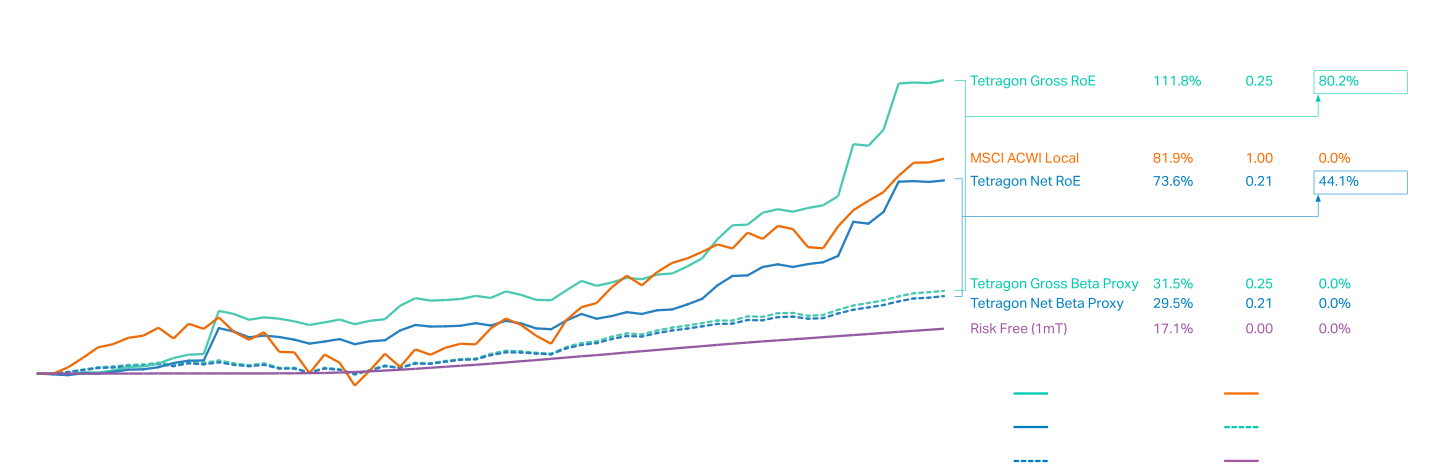
Over the five-year period through 31 December 2025, Tetragon’s total gross Return on Equity was +111.8% (+73.6% net), compared to +81.9% for the MSCI ACWI Local Index.(1) As shown in the graph below, over that five-year period, Tetragon’s portfolio exhibited lower equity market sensitivity as measured by relative equity beta(2) when compared to the MSCI ACWI Local Index, and generated gross alpha(3) of +80.2% (+44.1% net). The graph also shows Tetragon’s gross and net “beta proxy” over that period. A “beta proxy”(4) represents a hypothetical portfolio delivering the same beta-adjusted market exposure as Tetragon’s RoE, excluding any alpha. The difference, therefore, between Tetragon’s gross and net beta proxies and its gross and net RoE is the gross and net alpha generated over the period.
Over the same five-year period, Tetragon’s portfolio produced a Sharpe Ratio(5) of 1.3 on a gross basis (and 1.1 on a net basis), versus 0.8 for the Index.(6)
Five year cumulative alpha
(1) We refer to the MSCI ACWI Gross Total Return Local Index as the “MSCI ACWI Local Index”. Source: Bloomberg. Tetragon’s cumulative return over the five-year period is calculated by compounding its annual RoE over the five annual periods. The MSCI ACWI Local Index represents the performance of the MSCI ACWI Index if there were no foreign exchange fluctuations, similar to a portfolio with currency hedges, and with dividends reinvested, gross of any taxes. See also Note 12.
(2) Beta in financial performance is a measure of an investment’s or, in this case, a portfolio’s sensitivity to market movements, representing its volatility-adjusted correlation relative to a broad market index, such as the MSCI ACWI Local Index. The index definitionally has a beta of 1.0 to itself. A beta of less than 1.0 is understood to indicate that the portfolio, in this case, is less sensitive to a market index’s moves and therefore exhibits lower market risk.
(3) Alpha in financial performance is a measure of an investment’s or a portfolio’s return that cannot be explained by beta to a market index, such as MSCI ACWI Local Index.
(4) Each “beta proxy” is calculated using the Jensen’s Alpha framework applied to Tetragon’s applicable monthly RoE. For example, each monthly Tetragon Net Beta Proxy in the graph equals the risk-free rate (determined as the 1-month U.S. Treasury bill) plus its beta of 0.21 × (MSCI ACWI Local Index return − the risk-free rate).
(5) The Sharpe Ratio is a financial metric used to evaluate an investment’s return relative to its risk (volatility) and help determines if higher returns are due to the taking of excessive risk. A higher Sharpe Ratio indicates better risk-adjusted performance.
(6) All statistics are calculated using monthly datapoints. The risk-free rate used in the calculation of beta, “beta Proxies”, alpha and the Sharpe Ratio is the 1-month U.S. Treasury bill (source: Bloomberg). Beta, “beta proxies”, alpha and Sharpe Ratio statistics are calculated using Tetragon’s monthly RoEs as reported in Tetragon’s monthly factsheets. Ex-post standard deviation is calculated using the population methodology as described by the Global Investment Performance Standards (GIPS).
Email, news and alerts
Stay up to date with our latest news and events delivered direct to your inbox
By clicking on this link you are now leaving the Tetragon site and will join a third party site.
Welcome to Tetragon Financial Group Limited
Please read the Terms of Use below carefully. You must accept these terms before you can proceed.
TERMS OF USE OF THIS WEBSITE
Compliance with Applicable Laws and Regulations
The information on this website is for information purposes only. It does not constitute an offer to sell any security or investment product, nor does it constitute professional advice. Any product and service mentioned in this website are not offered to any person or entity in any jurisdiction or country where the advertisement, offer, solicitation, provision or sale of such product and service is restricted or prohibited by law or regulation or where Tetragon or any of its respective affiliates would be subject to any regulation or licensing requirement.
Users of this website are responsible for observing all applicable laws and regulations in their relevant jurisdictions before proceeding to access the information contained herein. By proceeding to access the information, users are deemed to have represented and warranted that the applicable laws and regulations of their relevant jurisdiction allow them to do so. No information contained on this website constitutes or would be deemed to constitute an invitation in any jurisdiction to invest or otherwise deal in Tetragon’s non-voting shares.
Restrictions on Ownership by U.S. Persons
Tetragon’s shares have not been and will not be registered under the United States Securities Act of 1933. Consequently, Tetragon shares may not be offered, sold or otherwise transferred within the United States or to, or for the account or benefit of, “U.S. persons” as defined in Regulation S under the Securities Act absent registration or an exemption from registration under the Securities Act. No public offering of any Tetragon shares is being, or has been, made in the United States.
In addition, Tetragon has not been and will not be registered under the United States Investment Company Act of 1940. Direct or indirect beneficial ownership of securities issued by Tetragon to any U.S. person who is not a “qualified purchaser” as defined in the Investment Company Act and applicable rules thereunder is prohibited. Under Tetragon’s Articles of Incorporation, the directors of Tetragon may in certain circumstances compel the transfer of any Tetragon shares owned directly or beneficially by any person who is not a “qualified purchaser”.
Furthermore, Tetragon shares may not be held by any “benefit plan investor” that is subject to Title I of the United States Employee Retirement Income Security Act of 1974. Tetragon’s Articles of Incorporation prohibit any “ERISA Person” from acquiring or holding Tetragon shares. The consequences of failing to comply with this prohibition include the divestment of the relevant shares and the forfeiture of any dividends previously received with respect to such shares, as well as any gains from their disposition.
Ownership by Persons in Europe
Tetragon’s non-voting shares are not intended for European retail investors. Tetragon anticipates that its typical investors will be institutional and professional investors who wish to invest for the long term and who have experience in investing in financial markets and collective investment undertakings and are capable themselves of evaluating the merits and risks of Tetragon shares and who have sufficient resources both to invest in potentially illiquid securities and to be able to bear any losses (which may equal the whole amount invested) that may result from the investment.
No Representation, Warranty or Reliance
No representation or warranty (including liability towards third parties), express or implied, is made as to the accuracy, reliability or completeness of any information contained on this website. Tetragon undertakes no duty to update any such information. Nothing contained on this website constitutes investment, legal, tax or other advice and is not to be relied on in making an investment or other decision. You should obtain relevant and specific professional advice before making any investment decision.
The information and opinions contained in this website are provided without any warranty of any kind, either expressed or implied, to the fullest extent permissible pursuant to applicable law. Neither Tetragon nor any of its affiliates further assumes any responsibility for, and makes any warranties that, information and supplies contained on this website will be uninterrupted or error-free, that defects will be corrected, or that this website or the servers that make it available will be free of viruses or other harmful components.
Forward-Looking Statements
Nothing in this website is, or should be relied on as, a promise or representation as to the future. This website contains forward-looking statements, which reflect the views of Tetragon with respect to, among other things, Tetragon’s operations. Investors can identify these forward-looking statements by the use of words such as “believe”, “expect”, “potential”, “continue”, “may”, “will”, “should”, “seek”, “approximately”, “predict”, “intend”, “plan”, “estimate”, “anticipate” or other comparable words. These forward-looking statements are subject to various risks, uncertainties and assumptions. Accordingly, there are or will be important factors that could cause actual outcomes or results to differ materially from those indicated in these statements. Should any assumptions underlying the forward-looking statements contained on this website prove to be incorrect, the actual outcome or results may differ materially from outcomes or results projected in these statements. Neither Tetragon nor any of its affiliates undertakes any obligation to update or review any forward-looking statement, whether as a result of new information, future developments or otherwise, except as required by applicable law or regulation.
Linked Sites
Tetragon has not reviewed any website linked to this website and Tetragon is not responsible for the contents of off-site pages or any other websites linked or linking to this website. If you follow any links off this website you do so at your own risk.
Links to this website may not be established without the prior written consent of Tetragon.
Liability Waiver
To the maximum extent permitted by applicable law, you agree that under no circumstances, including, but not limited to, negligence, shall Tetragon or any of its affiliates be liable for any direct, special or consequential damages that result from the access or use of, or the inability to access or use, the materials on this website.
Warning to Shareholders
Tetragon shareholders and investors in general are warned to be cautious of unsolicited offers to buy or sell Tetragon’s non-voting shares, and to always verify the legitimacy of any company or individual contacting them with respect to Tetragon, or purporting to act on behalf of Tetragon. They may do so by checking with a relevant regulatory body, such as the United States Securities and Exchange Commission, the United Kingdom Financial Conduct Authority or the Dutch Authority for the Financial Markets. Other than in connection with Tetragon’s announced tender offers from time to time to purchase Tetragon non-voting shares and Tetragon’s Optional Stock Dividend Plan for those shareholders electing to receive dividends in the form of Tetragon shares, Tetragon is not engaged, directly or indirectly through any third party, with any offering to purchase or sell Tetragon’s non-voting shares nor in providing general investment advice.
If you proceed to access the information included in this website, you acknowledge that you have read and agree with the above Terms of Use.